


What ERP Leaders Are Prioritizing in 2026 and What the Data Tells Us
As organizations move into 2026, ERP programs remain a central driver of digital transformation, operational efficiency, and long-term scalability. Despite years of innovation across ERP platforms, many organizations still face familiar challenges such as delays, complexity, and the need for stronger strategic guidance.
To better understand the priorities of ERP leaders for the year ahead, we conducted a series of LinkedIn polls throughout February 2026. The results provide a clear snapshot of the factors influencing ERP decisions today, including support preferences, program priorities, delivery challenges, and partner selection criteria. Below, we explore the data and its implications for ERP strategy.
ERP Support Is About the Full Journey
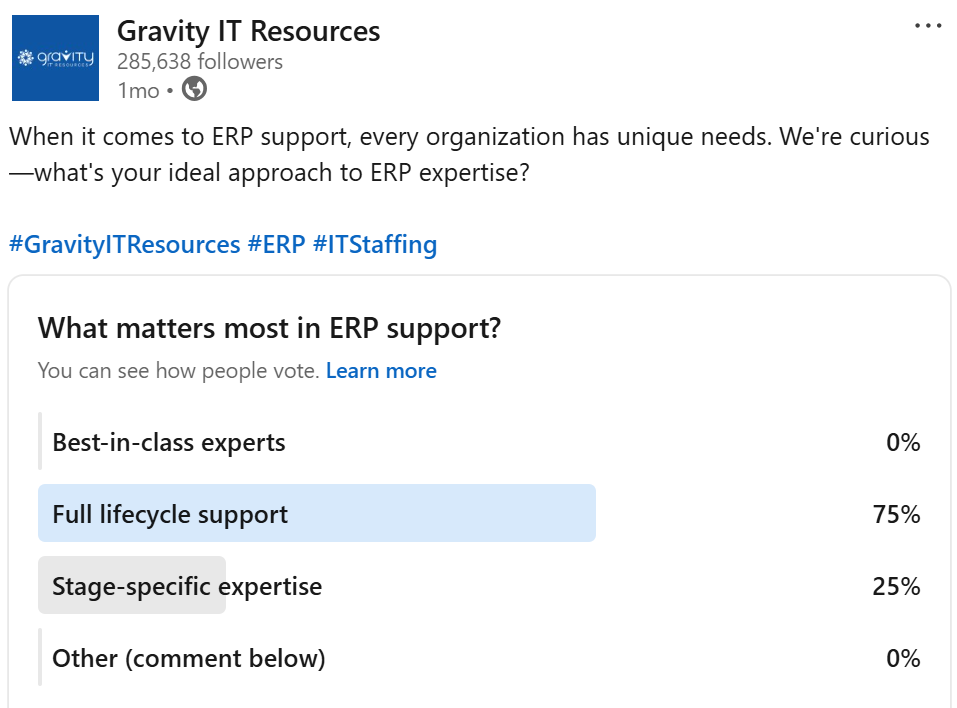
Poll Question: What matters most in ERP support?
- Full lifecycle support: 75%
- Stage-specific expertise: 25%
- Best-in-class experts: 0%
Organizations are not looking for isolated expertise. The strong preference for full lifecycle support indicates a desire for continuity—from roadmap planning and implementation to optimization and ongoing operations. ERP leaders want partners who understand how early decisions influence long-term outcomes.
ERP Priorities Are Split Between Change and Optimization
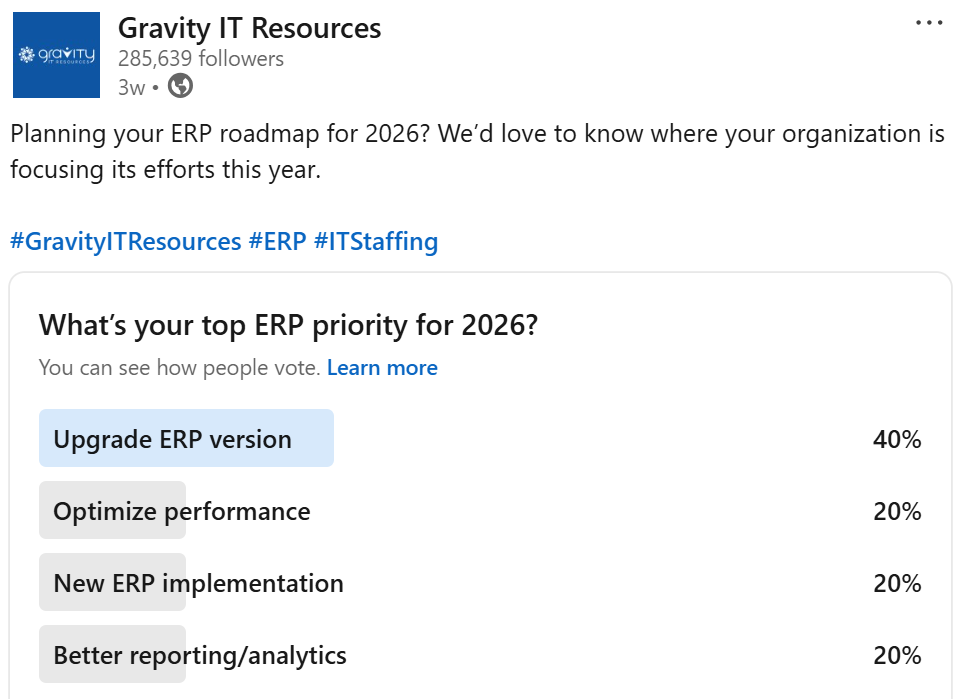
Poll Question: What is your top ERP priority for 2026?
- Upgrade ERP version: 40%
- Optimize performance: 20%
- New ERP implementation: 20%
- Better reporting and analytics: 20%
While system upgrades lead the list, the even distribution across optimization, implementation, and analytics highlights a balancing act many organizations face. They are modernizing their ERP platforms while also extracting more value from existing investments. ERP is increasingly seen as a driver of business performance, not just an IT initiative.
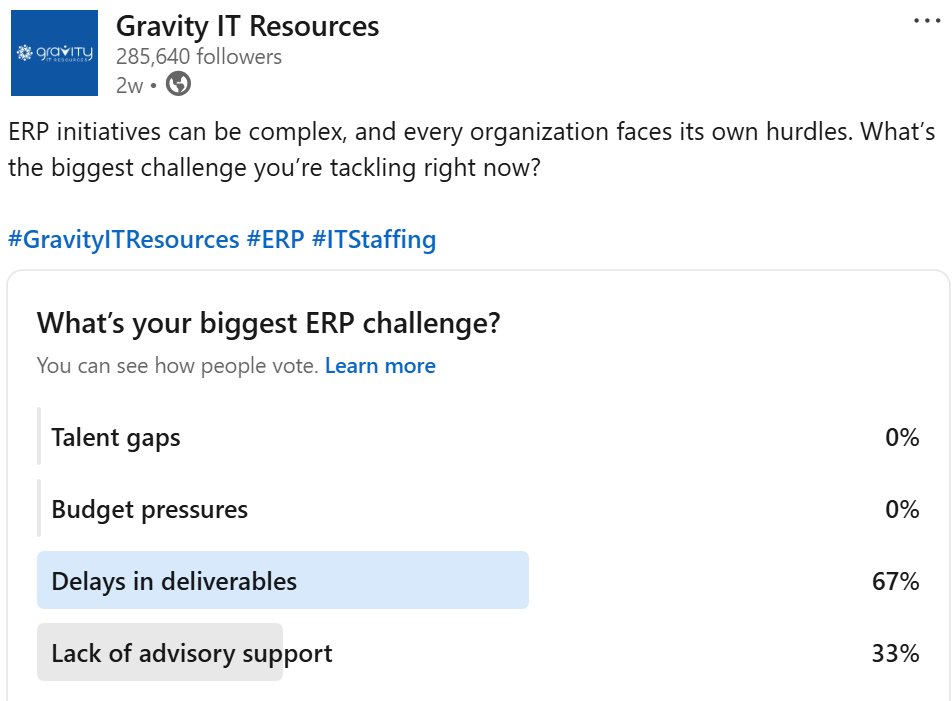
Delayed Deliverables Remain the Biggest Pain Point
Poll Question: What is your biggest ERP challenge right now?
- Delays in deliverables: 67%
- Lack of advisory support: 33%
- Talent gaps: 0%
- Budget pressures: 0%
Interestingly, talent shortages and budget pressures are not the primary concerns. Execution challenges, particularly delays, dominate. This suggests that governance, planning, and program structure play a larger role in ERP success than access to resources alone. Organizations are seeking stronger advisory alignment and disciplined execution to keep programs on track.
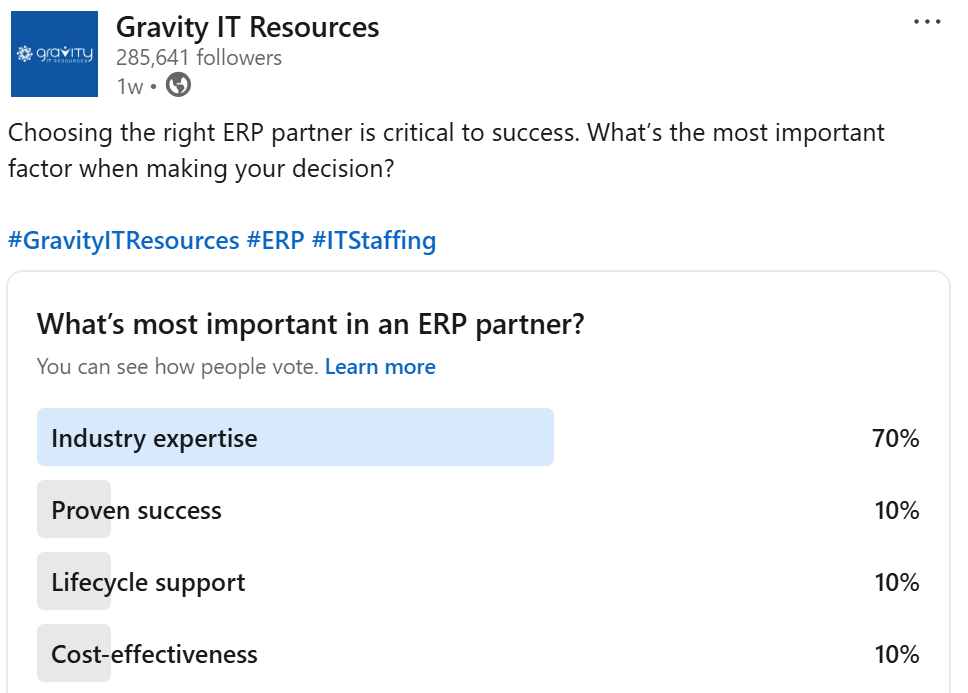
Industry Expertise Drives ERP Partner Selection
Poll Question: What is most important in an ERP partner?
- Industry expertise: 70%
- Proven success: 10%
- Lifecycle support: 10%
- Cost-effectiveness: 10%
Industry knowledge significantly outweighs cost or prior success metrics. ERP leaders want partners who understand the regulatory, operational, and process nuances of their specific industry. This expertise reduces risk and accelerates decision-making across complex ERP programs.
Advisory, Execution, and Specialized ERP Support
The poll findings align closely with broader trends in ERP programs. Organizations benefit most when ERP initiatives are supported by a consultative, end-to-end approach. This approach combines strategic advisory, execution-focused delivery, and access to specialized ERP talent exactly when it is needed.
Key ERP support capabilities include:
- Program Advisory and Consulting: Business case development, roadmap creation, PMO setup, governance frameworks, and delivery oversight
- ERP Staffing Solutions: Platform-specific expertise across Oracle, SAP, Workday, NetSuite, and more for upgrades, implementations, and transformations
- Flexible Delivery Models: Direct hire, contract, staff augmentation, and nearshore support to improve program outcomes
Successful organizations approach ERP as an evolving program rather than a one-time project. This ensures that strategy, execution, and expertise remain aligned as business needs change.
Conclusion
The February 2026 poll results highlight several key truths about today’s ERP landscape. Organizations value full lifecycle support, are balancing modernization with optimization, and continue to face execution challenges. Most importantly, they seek partners with deep industry knowledge, not just technical credentials.
As ERP programs grow more complex, the alignment of strategy, execution, and specialized expertise will be critical to achieving measurable results in 2026 and beyond.
About Gravity IT Resources
Gravity is a Human Capital Management company headquartered in Fort Lauderdale with offices across the country including Atlanta, Charlotte, Columbus, Cincinnati, Nashville, DC, Salt Lake City, San Diego and Tampa. Our company has been recognized by Inc. Magazine as an “Inc. 5000” award winner and one of the fastest growing privately held companies in the United States for the last 7 consecutive years (2019, 2020, 2021, 2022, 2023, 2024, 2025). Additionally, Gravity is proud to be Great Place to Work certified for the 5th year in a row (2021, 2022, 2023, 2024, 2025) and was also recognized on the SIA’s Fastest-Growing Staffing Firms in the US list the last two years (2024, 2025).
Gravity helps prominent clients like Salesforce, Chewy, Carnival Cruise Lines, AutoNation, Mosaic and hundreds of other enterprise and SMB companies to identify, recruit and hire IT professionals for their most critical projects and jobs. Our recruitment spans across various roles, including artificial intelligence (AI) specialists, software engineers, cloud engineers, project managers, data engineers, business analysts, security engineers, CXO leaders and more.
Gravity provides a variety of delivery models and services designed to meet client needs efficiently and effectively.
- Contract, Contract-to-Hire & Direct Hire of US-based Resources
- Nearshore Staff Augmentation
- Managed Team Services
- Executive Search
- ERP Program Leadership
- Workday Certified Staffing Partner
To learn more about Gravity IT Resources practices, career opportunities and culture, visit gravityitresources.com
